
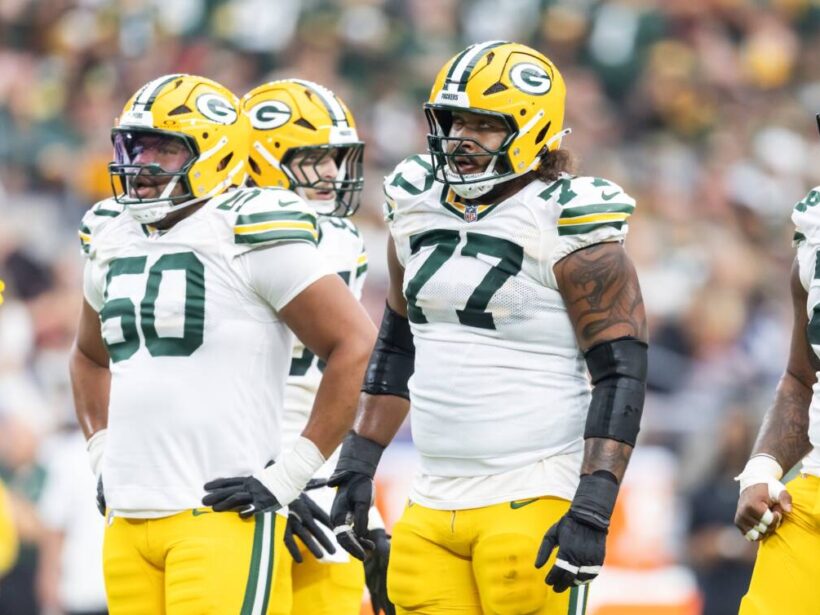
“Build the trenches” has long been an NFL mantra — and for good reason. Championships are often won and lost at the line of scrimmage. The Green Bay Packers Offensive Line embraced that philosophy during their most successful eras. If they hope to return to contention in 2026, it must once again start up front.
During their last Super Bowl run, Green Bay’s offensive line featured dependable, high-level performers such as Chad Clifton, Daryn Colledge, Scott Wells, Josh Sitton, and Bryan Bulaga. That group had continuity, physicality, and a clear identity.
The 2025 unit never quite found the same cohesion.
Injuries certainly played a role in the inconsistency, but as general manager Brian Gutekunst has pointed out before, every team deals with injuries. The best organizations adapt and maintain performance regardless.
High Expectations, Underwhelming Results
On paper, the 2025 offensive line appeared to be a strength. All-Pro Elgton Jenkins transitioned to center. The team invested heavily in left guard Aaron Banks. Former first-round pick Jordan Morgan and top-60 selection Anthony Belton added youth and upside. Zach Tom earned Pro Bowl recognition, and Rasheed Walker entered a contract year with momentum.
Statistically, however, the group underperformed relative to expectations and investment. Only one player ranked inside the top 10 at his position by Pro Football Focus. The unit struggled in both pass protection and run blocking, leading to uneven production for quarterback Jordan Love and running back Josh Jacobs. By several metrics, it was the least effective blocking unit Love has played behind since becoming the starter.
Interior Issues and Offensive Identity
Head coach Matt LaFleur wants to control games on the ground — establishing inside-zone runs, dictating tempo, and creating play-action opportunities downfield. When that interior push disappears, the entire offense becomes predictable.
Too often in 2025, Green Bay failed to generate movement between the tackles. Against elite defensive fronts, the run game stalled, forcing the offense into one-dimensional situations. That formula rarely succeeds in January. If the Packers intend to compete for another Lombardi Trophy, their offensive line must be capable of matching — and beating — the league’s top defensive lines like the Seattle Seahawks
Uncertainty Heading Into 2026
- – With Rasheed Walker likely departing in free agency, is Jordan Morgan ready to take over as the long-term solution at left tackle?
- – Can Aaron Banks rebound and justify the financial investment made in him?
- – If free agency weakens the interior depth, do the Packers have a reliable long-term answer at center?
- – Is the starting right guard currently on the roster?
- – Should Zach Tom move inside to center, even if it creates another vacancy at right tackle?
- – If the anticipated release of veteran Elgton Jenkins becomes official, who assumes the leadership mantle along the offensive line?
- – With the recent infusion of youth, does the unit need more veteran presence in the locker room?
Gutekunst has previously emphasized positional versatility, suggesting Morgan could play multiple spots if needed. Tom’s athletic profile and intelligence make him a candidate to shift to center — a move Gutekunst has publicly entertained. But shifting Tom would create another vacancy at right tackle, potentially solving one issue while creating another.
Complicating matters further are cap constraints and limited draft capital. The Packers cannot simply outspend or out-draft the problem; they must develop and maximize the talent already in the building.
The Bottom Line
The Packers enter the 2026 offseason with more questions than answers along the offensive line. For a team that has invested heavily in the trenches, the return has not matched the resources allocated.
If Green Bay is going to take the next step — and give Jordan Love the environment he needs to elevate the offense — rebuilding cohesion, toughness, and consistency up front must be the top priority.
