
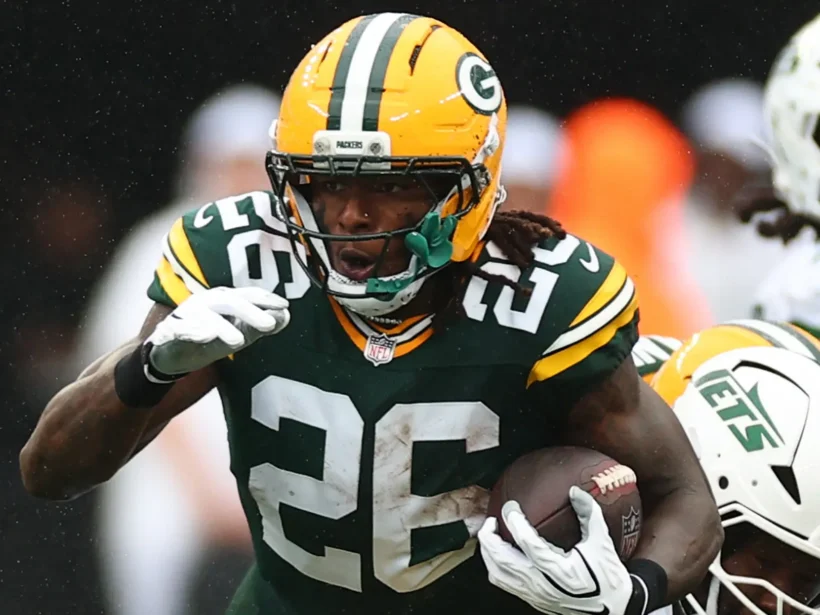
Two weeks into the season, the Green Bay Packers are still searching for answers at running back. Maybe they already found one.
Kaleb Johnson entered Sunday’s game against the New York Jets as something of an afterthought in Green Bay’s backfield. He got no carries in Week 1 against Minnesota. MarShawn Lloyd entered the season atop the depth chart with Josh Jacobs out, while Chris Brooks kept a role because of his reliability in pass protection and on special teams.
Then Johnson finally got his opportunity. Eight carries. Thirty-two yards. Four yards per attempt. Three first downs.
Those numbers won’t jump off the page, but Johnson led Green Bay in both rushing attempts and rushing yards in its 20-17 overtime win over New York. Lloyd finished with six carries for 20 yards, while Brooks had four carries for 11.
More importantly, when the Packers desperately needed someone to make a play in overtime, Johnson got the ball. It is time to see what happens when he gets it a lot more.
Johnson Earned Another Opportunity
Johnson’s best run against New York might have also been his most important.
After the Packers defense forced a three-and-out to begin overtime, Green Bay took possession at its own 34-yard line. On the first play of the drive, Johnson ripped off an 11-yard run. Green Bay was suddenly moving.
Brooks caught a 15-yard pass, the Jets committed a penalty, and a 14-yard completion to Matthew Golden set up Trey Smack’s game-winning field goal. It was only one run, but the situation mattered.
The Packers had just completed a fourth-quarter comeback. The game hung in the balance, and Matt LaFleur’s offense opened its overtime possession by putting the ball in Johnson’s hands. That should not be overlooked.
Johnson had already shown some juice earlier in the game, including a 12-yard run up the middle in the first quarter and a seven-yard run that helped move Green Bay into the red zone during the second quarter.
For a player who had zero offensive snaps against Minnesota, that is quite a jump. Now the Packers should take the next one.
The MarShawn Lloyd Experiment Hasn’t Taken Off
That doesn’t mean the Packers should give up on MarShawn Lloyd. It does mean they need to stop treating the starting job like it belongs to him by default.
Lloyd received 13 carries for 37 yards against Minnesota before following that performance with six carries for 20 yards against the Jets. His offensive snap share also dropped from 44% in Week 1 to 27% in Week 2.
Then came the fumble against New York. Lloyd did not record another touch afterward.
He still has a role in this offense. His explosiveness makes him intriguing, and the Packers have waited a long time to finally see what a healthy Lloyd can do.
But availability and potential can only carry the conversation for so long. Eventually, production has to decide playing time. Right now, Johnson deserves the chance to prove he can do more for Green Bay.
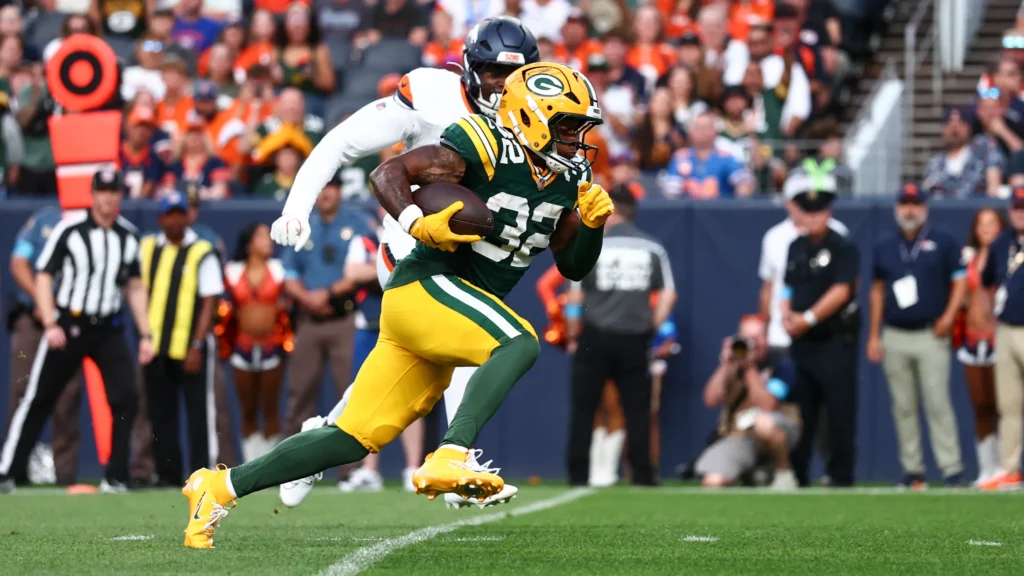
Johnson Was Built for Packers Offense
Green Bay also wanted Johnson for a reason.
General manager Brian Gutekunst admitted after acquiring him that the Packers liked Johnson during the 2025 pre-draft process. Green Bay eventually landed him a year later, sending Pittsburgh a 2028 sixth-round pick.
At 6-foot-1 and 224 pounds, Johnson has the size to handle a legitimate workload. During his final season at Iowa, he carried the ball 240 times for 1,537 yards and a school-record 21 rushing touchdowns. He averaged 6.4 yards per carry and scored 23 total touchdowns.
More importantly, look at how he did it. Johnson thrived in zone concepts at Iowa. One pre-draft breakdown charted 80% of his 2024 runs as zone concepts and noted his production after contact and ability to create explosive runs.
That matters in Green Bay. Johnson is not necessarily the kind of back who will dance around three defenders behind the line of scrimmage and magically turn a broken play into a 40-yard touchdown.
That isn’t his game. Give him a crease, let him read the blocks, plant his foot and get downhill.
At 224 pounds, those four-yard gains can become six-yard gains as a defense gets tired. The six-yard gains can eventually become the explosive runs Johnson routinely produced at Iowa.
Give Jordan Love a Running Game Again
The bigger issue here goes beyond Johnson. The Packers need their running game back.
Green Bay rushed for only 66 yards in its Week 1 loss to Minnesota. Against the Jets, its three running backs combined for just 63 yards on 18 carries.
That isn’t enough. This offense becomes much harder to defend when the running game forces defenses to respect everything Matt LaFleur can throw at them.
Play-action becomes more dangerous. The linebackers have to hesitate. The bootleg game opens up. Jordan Love gets cleaner throwing windows. Suddenly, all the motion and misdirection LaFleur loves has teeth.
Without a legitimate threat on the ground, defenses can dictate the game instead. Green Bay can’t let that become the identity of this offense.
And sometimes the answer isn’t changing the scheme. Sometimes it is changing who gets the football.
Chris Brooks Still Has an Important Role
Starting Johnson also doesn’t mean Brooks disappears. Quite the opposite.
Brooks has played the highest percentage of offensive snaps among Green Bay’s running backs through two games, including 56% against Minnesota and 46% against New York. His value extends beyond carrying the ball, especially because of what he provides as a blocker.
Keep using him there. Let Brooks handle passing situations. Let Lloyd provide a change of pace and give Green Bay another explosive option.
But when the Packers line up and need someone to establish the running game? Give Johnson the football. There is no reason this needs to remain a completely even three-man committee.
Time For Packers To Find Out What Kaleb Johnson Can Be
Nobody should crown Johnson after eight carries. That would be ridiculous.
His NFL résumé remains extremely small. Pittsburgh drafted him in the third round in 2025, and his rookie season produced only 69 rushing yards on 28 carries before the Steelers traded him to Green Bay. Pittsburgh was willing to move on for a reason.
Green Bay also had a reason to give something up to acquire him. The Packers saw a 23-year-old running back with size, vision, college production, and a skill set that could fit what they want to do.
Now they need to actually find out what they have.
Give Johnson 15 carries against Atlanta. Let him establish a rhythm instead of rotating backs every few snaps.
Give him a chance to wear down a defense and show whether the player who rushed for more than 1,500 yards in his final season at Iowa can translate that style to the NFL.
If he struggles, Green Bay can adjust. But after what we saw against the Jets, he has earned the first opportunity.
The Packers entered this season looking for someone to emerge from a crowded backfield. Kaleb Johnson finally got his chance Sunday. Now Green Bay should give him the job.
