
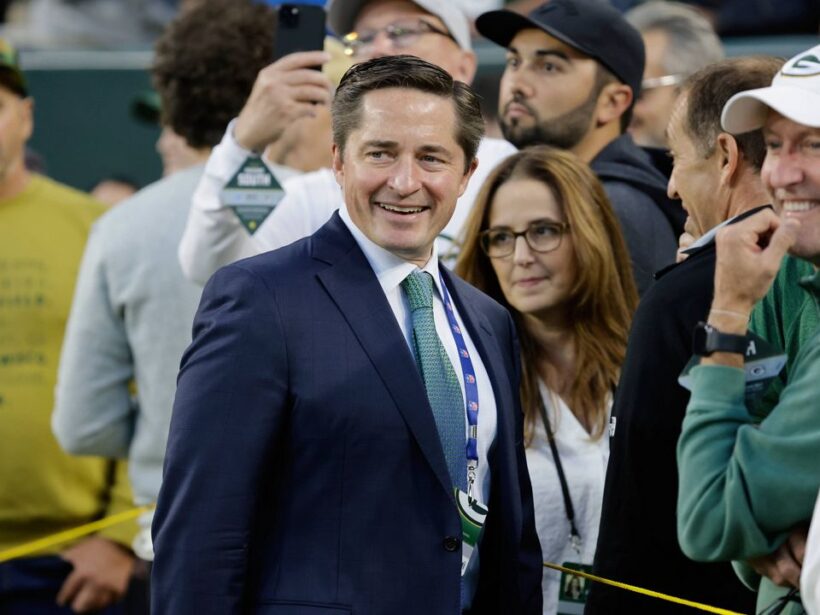
The Green Bay Packers are one of the most unique professional sports teams when it comes to their location and ownership structure, and since Ed Policy took over as team president in July of last year, there’s been a renewed focus on keeping it that way.
The battle to maintain the Packers’ foothold in Green Bay has been fought since the team’s inception, and it continues to be an uphill one.
With the Packers’ biggest rival facing their own challenges with their city, let’s take a moment to check in on where things stand one year on.
A Continued Priority
When Ed Policy was first introduced as the heir to Mark Murphy in 2025, he made it clear that beyond winning championships, one of, if not his biggest priority was keeping the Packers in Green Bay.
At first glance, that seems like a given.
The Packers are synonymous with their city in a way that surpasses some of the nation’s most iconic franchises, but as of late, the conversation has ramped up in regard to keeping the Packers in the game.
In an era in which privately owned teams are gaining more and more access to additional revenue streams, Ed Policy addressed his concerns for the Packers’ future in March, thanks to an interview with the Sports Business Journal.
Policy expressed that the Packers are at somewhat of a disadvantage when it comes to controlling their revenue, thanks to the fact that other high-spending NFL owners are now able to sell small portions of their teams to private equity without giving up any meaningful control.
With the Packers being publicly owned, selling stake isn’t an option unless they were to pursue another round of stocks, and historically, the NFL has limited how the Packers can use those funds, most recently for upgrades to Lambeau Field following Super Bowl XLV.
So, what options do the Green Bay Packers have?
Beyond raising ticket prices and expanding the Titletown district, there’s one elephant in the room, and that’s the naming rights to Lambeau Field.
Ed Policy has gone on the record to say that he doesn’t plan to consider any deal of that nature any time soon, but it could be coming down the pipeline eventually, especially when some of the most recent developments come into play.
The Latest Challenge
In mid-June, the Green Bay Packers came out against the U.S. Department of Justice’s investigation into the NFL’s use of the Sports Broadcasting Act.
Established in 1961, the act dictates how the NFL negotiates its broadcast rights, which are a large source of revenue for the Packers.
Currently, most other professional sports have deals on a regional basis, which is why you see networks like Marquee for the Chicago Cubs.
The NFL, on the other hand, operates on equal-share system, which allows the Packers to keep up with teams in better markets.
Last year, that was to the tune of a record 432.6 million dollars, according to the Packers’ financial records via Rob Demovsky.
Without that pooling of funds, the Packers could take a massive hit, and as such, team leadership took issue with the stance of Wisconsin’s own representative, Scott Fitzgerald, who’s been leading the charge in regard to changes.
Fitzgerald called the Packers’ concerns “almost laughable,” and in turn, the Packers released the following statement:
It’s uncommon to see the Green Bay Packers come to such significant opposition of something as an organization, and moving forward, the situation will be something to monitor.
Considering how one of the NFL’s other long-standing franchises, the Chicago Bears, have essentially been pushed out of their city, I think there’s reason for some level of concern, especially if significant changes come to pass.
Until then, our rivals can keep Indiana for themselves.
