
Every NFL season begins with optimism, but championship contenders are ultimately defined by how they answer difficult questions over the course of the year.
The Green Bay Packers enter the 2026 campaign with legitimate ambitions, yet their path toward Super Bowl LXI will depend on more than raw talent. Player development, coaching transitions, health, and a demanding schedule all have the potential to shape the outcome.
Green Bay possesses an intriguing blend of experienced veterans and ascending young contributors. The roster has enough depth to compete with the NFC’s best teams, but maintaining consistency throughout a long season will require key individuals and position groups to meet elevated expectations.
These five questions could ultimately determine whether the Packers remain contenders deep into January.
1. Can Jordan Love Reach Elite Status?
Jordan Love enters the 2026 season carrying higher expectations than ever before after continuing to establish himself as Green Bay’s franchise quarterback. Another productive year would reinforce his place among the NFC’s top passers, but taking the next step requires greater consistency against elite defenses.
As analysts evaluate Green Bay Packers odds throughout the season, Love’s performance will remain one of the biggest factors influencing expectations. His ability to consistently deliver from the pocket may prove more significant than any offseason addition or tactical adjustment.
Improving his pocket footwork remains an important objective. Cleaner movement under pressure can help Love maintain throwing mechanics, extend plays without abandoning structure, and create more opportunities for explosive gains through the air.
Polished quarterbacks elevate every aspect of the offense, from protecting possessions to maximizing the receiving corps. If Love continues refining his game, Green Bay’s offensive ceiling rises considerably. His development remains the single most important ingredient in the Packers’ pursuit of a championship.
2. How Long Without Micah Parsons?
Green Bay faces an early challenge after Micah Parsons sustained a knee injury that is expected to sideline him for the opening portion of the season. While the long-term outlook remains encouraging, immediately replacing the impact he provides will test the depth of the defensive front.
Without Parsons generating consistent pressure, Green Bay must rely on multiple defenders to create disruption rather than expecting one player to dominate opposing offensive lines. Generating pressure through rotation and scheme will become increasingly important during his absence.
Players such as Lukas Van Ness, Barryn Sorrell, and Collin Oliver will likely shoulder greater responsibility. Their ability to maintain production could prevent opposing quarterbacks from becoming too comfortable during the season’s opening weeks.
The defense’s confidence often grows through early success, making this stretch particularly significant. Parsons’ eventual return should provide a considerable boost, but how Green Bay performs before then may shape momentum for the remainder of the campaign.
3. Can the Defense Adapt to Gannon?
Jonathan Gannon’s arrival as defensive coordinator introduces a new philosophy that emphasizes flexibility, disguise, and disciplined execution. Gannon’s system has delivered notable success in previous stops; however, Green Bay’s players will still need time to become fully comfortable with its terminology and responsibilities.
The transition toward a shifting 3-4 base alignment asks defenders to process assignments differently while maintaining gap discipline and communication. Small adjustments in positioning and responsibilities can significantly influence overall defensive efficiency.
Early-season growing pains wouldn’t be surprising as veterans and younger contributors adapt to new terminology and concepts. Communication within the front seven and secondary becomes especially important when implementing more complex coverage rotations and pressure packages.
How quickly the defense develops chemistry may influence several close contests during the opening months. If the unit embraces Gannon’s approach and executes consistently in 2026, Green Bay could establish one of the NFC’s more balanced defenses.
4. Who Steps up at Receiver?
The Packers’ receiver room enters 2026 with a different look after offseason departures reshaped the depth chart. Those changes create opportunities for returning playmakers while placing greater responsibility on younger contributors to expand their roles.
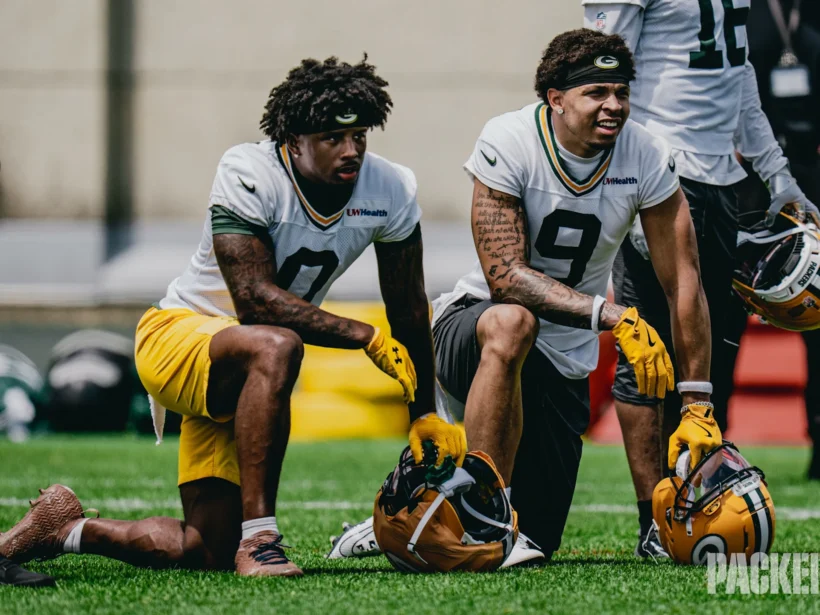
Christian Watson remains one of the offense’s most explosive vertical threats, while Jayden Reed continues developing into a dependable option across multiple alignments. Second-year receiver Matthew Golden enters camp with expectations of assuming a larger role after an uneven rookie season.
NFL statistics show that balanced production across the receiving corps will be essential. Rather than relying on one dominant target, Green Bay benefits when multiple receivers consistently create separation and force defenses to defend every area of the field.
Reliable target distribution also supports Jordan Love’s continued growth by allowing him to take advantage of favorable matchups throughout games. If the receiving group develops together, the offense becomes significantly more difficult for opponents to contain.
Navigating a Demanding 2026 Schedule
Green Bay begins its season with an important road test against the Minnesota Vikings on September 13, immediately setting the tone for what promises to be one of the league’s more demanding schedules.
The challenge intensifies during Weeks 5 through 7, when consecutive games against the Chicago Bears, Dallas Cowboys, and Detroit Lions provide little margin for inconsistency. Each opponent presents different tactical challenges that will test both preparation and adaptability.
The closing stretch may prove equally significant. Matchups against the Buffalo Bills, Miami Dolphins, Chicago Bears, and Houston Texans feature several teams expected to contend for postseason positions. This schedule provides meaningful late-season opportunities to measure Green Bay against elite competition.
Successfully navigating this demanding period will require consistent contributions throughout the roster rather than relying solely on star players. If the Packers handle these difficult stretches effectively, they’ll strengthen their position entering the race toward Super Bowl LXI.
The Road Ahead
Championship seasons are rarely defined by one moment alone. Instead, they emerge through consistent answers to the biggest questions that arise throughout the year. Jordan Love’s continued development, defensive adjustments, health, receiver production, and success against a demanding schedule will collectively shape Green Bay’s outlook.
If the Packers respond well in each of these areas, they will place themselves in a strong position to compete with the NFC’s best teams throughout the 2026 season.
