
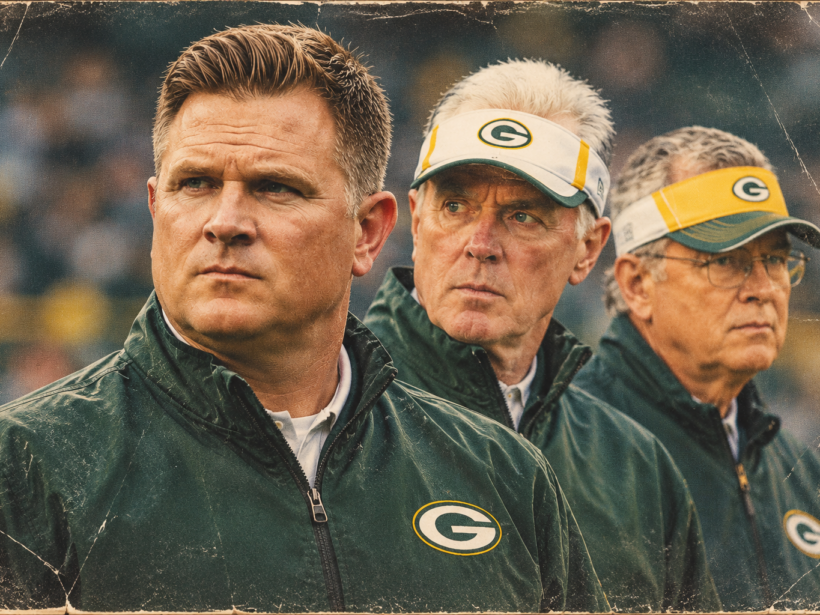
This time last year, the Green Bay Packers appeared to be a legitimate Super Bowl contender.
Fast forward to today, and a lot of Packers fans are asking the same question:
How did we get here?
For as long as I can remember, Green Bay has been known as “Titletown.” Unfortunately, Titletown has been absent of a title for more than a decade and a half.
Sure, you can point to the obscene number of injuries to key players dating back to November of 2025, along with the handful of season-ending injuries the Packers have already suffered this season. Those are debilitating losses for any team.
But every team deals with injuries.
The difference is how prepared you are to withstand them.
The Packers have invested significant resources into building this roster, particularly through the draft. When injuries inevitably hit, those investments are supposed to provide the depth necessary to survive them.
Too often, they haven’t.
And that’s why I don’t think injuries alone explain what has happened in Green Bay.
The Standard
When Brian Gutekunst took over as general manager, he referenced the influence of former Packers GM Ron Wolf and the philosophy he learned working under him.
Wolf took over a struggling franchise in late 1991. Within five years, the Packers were Super Bowl champions, led by Brett Favre and Reggie White.
Ted Thompson took over as general manager in 2005. Six seasons later, Green Bay was again hoisting the Lombardi Trophy, with a roster built around players such as Aaron Rodgers, Clay Matthews, B.J. Raji and Charles Woodson.
Brian Gutekunst is now in his ninth season as general manager.
Bill Walsh famously believed coaches should change jobs after roughly 10 years or risk having their message grow stale. Whether you agree with that philosophy or not, it’s interesting when applied to the current Packers.
Matt LaFleur is in his eighth season as head coach.
This isn’t to say either man has been unsuccessful.
Far from it.
Gutekunst has made plenty of great moves during his tenure and constructed rosters capable of competing deep into January. LaFleur has won a lot of football games and helped oversee the transition from one franchise quarterback to another.
But eventually, regular-season success has to lead somewhere.
And lately, it hasn’t.
More concerning is what appears to be a drop-off in the decision-making and roster-building process over the past few seasons. Those misses are beginning to compound, and they’re affecting a team that hasn’t felt like it’s been trending in the right direction since midway through last season.
It’s easy to point to injuries when explaining the Packers’ struggles.
It’s harder to use them as the entire explanation when this same team walked into Chicago last January, built a 21–3 halftime lead in a playoff game despite dealing with many of those injuries, and somehow found a way to lose 31–27.
That game wasn’t lost because Green Bay didn’t have enough talent to win.
They had already proven they did.
They simply couldn’t finish.
That’s why it’s becoming increasingly difficult for me to accept injuries as the primary explanation for what we’re seeing now.
The Only Way to Grow Is to Change
The reality is that both Brian Gutekunst and Matt LaFleur are approaching a decade in their respective positions.
During that time, we’ve seen tremendous regular-season success.
We’ve also seen repeated postseason disappointment.
At some point, you have to ask whether an organization begins to take on the identity of the people who have been leading it for nearly a decade.
For years, the Packers’ roster-building mantra has essentially been draft and develop.
There have unquestionably been hits. But a philosophy built around drafting and developing players only works if those players are ready when their opportunities arrive.
This season has put a magnifying glass on that process.
Ty’Ron Hopper was a top-100 selection in 2024, yet through his first two seasons he contributed primarily on special teams. MarShawn Lloyd was another top-100 selection that year, but injuries have prevented him from establishing himself as a dependable piece of the offense. When given the opportunity to fill in for Josh Jacobs, Lloyd hasn’t ceased the opportunity.
Now look at wide receiver.
The Packers lost Jayden Reed to a frightening neck injury that will keep him out for the remainder of the season. Savion Williams, another third-round pick in 2025, began this season on injured reserve and has yet to develop into the contributor many hoped he could become.
This is where draft-and-develop is supposed to pay off.
Nobody expects a third-round pick to immediately replace Jayden Reed. Nobody expects a young linebacker to step onto the field and instantly replicate the production of an established starter.
But high-priority draft picks eventually have to become dependable NFL players.
Injuries are inevitable. Every general manager knows that when constructing a roster. You can’t completely replace a star when he goes down, but you should be able to trust the player behind him to step onto the field and keep the operation functioning.
Too often lately, Green Bay hasn’t been able to do that.
And when injuries expose the same positions where you’ve repeatedly invested valuable draft capital, eventually the conversation has to move beyond bad luck.
It becomes a roster-construction problem.
Has This Era Run Its Course?
I’ll always be a Packers optimist.
But I’m beginning to wonder whether the grass actually might be greener on the other side.
Maybe Green Bay doesn’t need another offseason of minor adjustments.
Maybe it needs a new chapter.
A fresh general manager brings a different philosophy toward roster construction. A fresh head coach brings a different voice, different expectations and potentially an entirely different identity.
We’ve seen how quickly that can change the trajectory of an NFL team.
Look at Atlanta. The Falcons moved on from Raheem Morris and brought in Kevin Stefanski, an experienced head coach with a clearly defined offensive philosophy. It’s still far too early to know how successful that experiment will ultimately be, but sometimes organizations simply reach a point where a different voice and a different approach are necessary.
And that brings me to perhaps my biggest concern with Matt LaFleur.
I’ve written about it before, and I still don’t love what I perceive as the soft nature of this football team.
Watch Chicago Bears head coach Ben Johnson. Whether you like him or not, there is an edge to him. He talks openly about beating division opponents. He projects confidence and aggression, and his team appears to have adopted some of that personality.
Then I look at Green Bay.
LaFleur has made comments about not enjoying beating friends in the coaching profession. We’ve watched him become emotional discussing his players after difficult losses.
There’s nothing inherently wrong with caring deeply about your players. In many ways, it’s one of LaFleur’s best qualities.
But there also has to be an edge.
Football requires more than drawing up the perfect third-down concept.(And lately those haven’t been great either)
It requires convincing 53 men that when they walk onto a field on Sunday, they’re going to impose their will on the team across from them.
And too often, I don’t know which Packers team is going to show up.
That’s the problem.
There is no questioning LaFleur’s talent as an offensive coach. He’s one of the better offensive minds in football. He deserves significant credit for Jordan Love’s development.
He also deserves credit for helping revitalize Aaron Rodgers late in his Packers career. Rodgers looked like a quarterback whose best football might have been behind him before LaFleur arrived, then went on to win back-to-back MVP awards.
Those things matter.
But being an NFL head coach requires more than calling plays.
There is a psychological component to preparing a football team. There’s an identity that great teams develop. You can see it when they take the field. You know they’re prepared. You know what they’re going to look like. And even when things go wrong, you trust how they’re going to respond.
When was the last time you consistently felt that way about the Packers?
Instead, we’ve watched inexplicable home losses become increasingly normal. We’ve watched Green Bay play down to inferior opponents. We’ve watched comfortable leads disappear. We’ve watched playoff games that appeared to be under control somehow slip away.
At a certain point, those stop feeling like isolated incidents.
They become part of your identity.
And that’s what concerns me most.
Brian Gutekunst and Matt LaFleur have both done a lot of good for the Green Bay Packers. Their tenures shouldn’t be remembered as failures if this is ultimately where they end.
But success in Green Bay isn’t supposed to be measured solely by winning seasons, playoff appearances or being competitive.
The standard is championships.
This is Titletown, after all.
And after nearly a decade under the same leadership, it’s fair to ask whether the people who helped get the Packers this far are still the people capable of getting them where they ultimately want to go.
Sometimes the only way to grow is to change.
Maybe it’s time for Green Bay to turn the page.
