
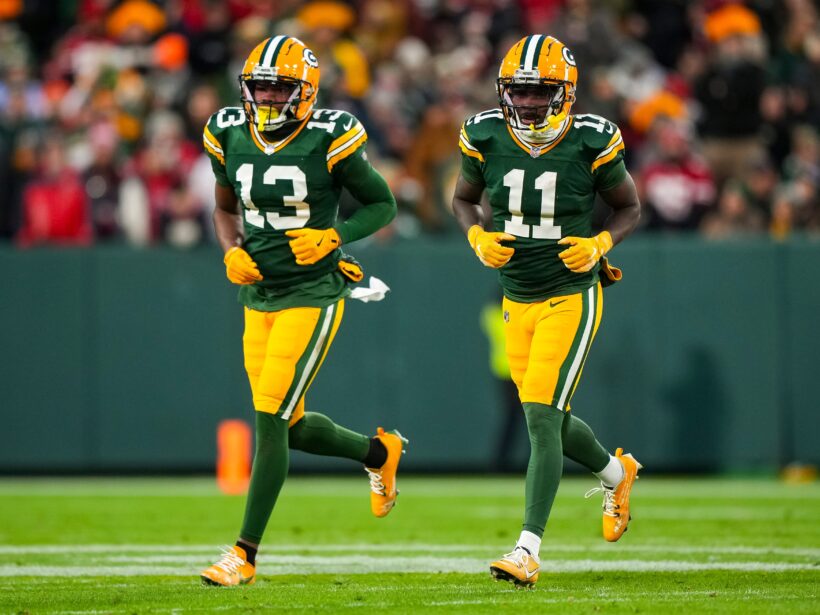
Since 2022, no NFL team has invested more draft capital into the wide receiver position than the Green Bay Packers. As the franchise enters the 2026 season, that aggressive approach may have created an unexpected problem—too many mouths to feed.
Green Bay’s long-term priorities remain clear. Securing extensions for Christian Watson and tight end Tucker Kraft sits near the top of the organizational agenda. At the same time, former first-round pick Matthew Golden appears poised to step into a prominent WR2 role, while 2025 third-round selection Savion Williams is expected to carve out a larger share of the offense.
Beyond that core, the situation becomes more complicated. Jayden Reed, Dontayvion Wicks, and Luke Musgrave are all entering contract years, creating a crowded and highly motivated group of pass catchers. Each will be looking to maximize production and leverage ahead of potential paydays, intensifying competition within an already deep room.
Green Bay South?
Across the league, a new opportunity may be emerging.
The Miami Dolphins made headlines this week by trading star wide receiver Jaylen Waddle in exchange for first-, third-, and fourth-round picks in the 2026 NFL Draft. In the immediate aftermath, Miami’s receiving corps—featuring Malik Washington, Jalen Tolbert, and Tutu Atwell—lacks proven top-end production.
That raises legitimate questions about direction. Quarterback Malik Willis, who recently signed a three-year, $67 million deal, now finds himself leading an offense with limited established weapons. Whether Miami intends to rebuild quickly or undergo a more patient reset remains to be seen.
Armed with seven top-100 selections in April’s draft, General Manager Jon-Eric Sullivan has the flexibility to reshape the roster. However, for a team with multiple needs, allocating significant resources to a single position group may not be the most efficient path forward.
Familiarity Matters
One factor working in Green Bay’s favor—or potentially Miami’s—is existing chemistry.
While Watson and Romeo Doubs have operated as primary starters, Willis built meaningful rapport in practice with both Jayden Reed and Dontayvion Wicks. That familiarity carries real value, particularly for a quarterback still establishing himself as a long-term solution.
In a crowded receiver room, that dynamic opens the door for a logical outcome: a trade.
Both Reed and Wicks are entering contract years, and a move to Miami could offer expanded roles and increased market value ahead of free agency. From the Dolphins’ perspective, acquiring young, ascending talent provides flexibility—either as long-term building blocks or as assets that could yield compensatory picks if not retained.
There’s also a subtle but relevant layer of continuity. Both players train in Florida during the offseason, making the transition to Miami relatively seamless.
Snow Bird
Jayden Reed’s situation deserves particular attention.
After suffering a broken collarbone in Week 2 last season, Reed did not return until Week 14 in a limited capacity. Despite the setback, his 2024 production closely mirrors what Jaylen Waddle delivered in 2025—a comparison that underscores Reed’s potential when healthy.
Shortly after the Packers selected Matthew Golden, reports surfaced that General Manager Brian Gutekunst met with Drew Rosenhaus to reaffirm Reed’s standing as a key piece of the offense. At the time, the move raised eyebrows. Reed, while productive, has often been viewed as a complementary option rather than a true alpha receiver in the mold of Ja’Marr Chase or Justin Jefferson.
Now, with Golden entering the picture, there is a degree of skillset overlap. Golden’s emergence could complicate Reed’s long-term role in Green Bay, particularly when considering future financial commitments.
From a roster construction standpoint, retaining Dontayvion Wicks may present a more cost-effective option while also offering a differentiated skillset—especially with Romeo Doubs departure.
Where Do the Packers Go From Here?
As free agency enters its later waves, the available talent pool has largely shifted toward veterans and reclamation projects. For teams looking to make meaningful improvements, attention has turned toward April’s draft.
However, Green Bay finds itself in a unique position. With limited draft capital and no first-round pick, the Packers lack the traditional flexibility to reshape their roster through rookie additions.
That reality makes alternative avenues—particularly trades—far more compelling.
The question now becomes clear:
Would moving one of Green Bay’s young pass catchers serve both the team’s long-term roster balance and the player’s individual opportunity?
Given the current landscape, it may not just be an option—it may be the most logical next step.
