
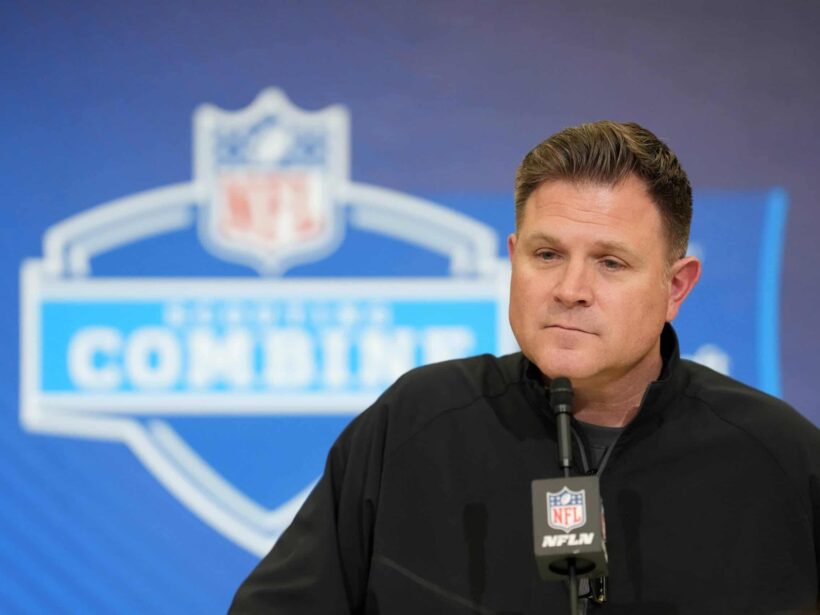
In just a few weeks, Brian Gutekunst will enter his ninth NFL Draft—and he’s made one thing abundantly clear: in Green Bay, traits matter, and athleticism sits at the center of the draft process.
For better or worse, the Packers have consistently leaned into measurable upside. Production still carries weight, but Gutekunst’s track record shows a willingness to bet on elite testing numbers—particularly through the widely adopted Relative Athletic Score (RAS) model.
The scoring system evaluates a player’s height, weight, bench press, speed, explosiveness, and agility testing—either at the NFL Combine or a Pro Day. When testing is incomplete, Green Bay has historically leaned on agility drills like the 20-yard shuttle and 3-cone, followed by explosion metrics such as the vertical and broad jump.
A perfect score is 10.0, and anything above 8.0 is widely considered high-level. It’s also important to note the formula is position-specific—what qualifies as elite for a running back differs from an offensive lineman.
With the NFL Draft just weeks away, here’s how that philosophy could shape the Packers’ offensive approach.
Quarterback: Development Over Investment
The sample size remains small. Outside of Jordan Love, Gutekunst has only spent one draft pick at quarterback—on Sean Clifford. That alone suggests Green Bay is comfortable developing behind a starter rather than aggressively investing draft capital.
With depth options already in place, the more likely route is a developmental addition—perhaps via undrafted free agency. Arkansas dual-threat QB Taylen Green fits the mold: 6’6”, 224 pounds, who threw for 2,700 yards and 19 touchdowns while adding 780 rushing yards and 8 scores in his senior season.
Running Back: High-End Traits, Strategic Timing
Josh Jacobs enters his third year in Green Bay as the foundation of the run game, but questions remain behind him. Marshawn Lloyd’s health looms large, while Chris Brooks has shown flashes in limited opportunities—particularly as a pass blocker.
The departure of Emanuel Wilson only adds to the uncertainty, making this a position worth monitoring.
Arkansas’ Mike Washington Jr. checks every box Gutekunst covets. At 6’1”, 223 pounds, Washington posted a perfect 10.0 RAS—ranking No. 1 out of 2,115 running backs tested since 1987. A projected second-round pick, he would likely require premium draft capital. With both the size and athletic testing, Washington is reminiscent of 2020 second-round pick A.J. Dillon
If Green Bay opts to wait, a late-round option like Kaelon Black—5’10”, 208 pounds and fresh off a national championship with Indiana—fits the profile of past selections such as Kylin Hill.
Wide Receiver: Defined Archetypes, New Opportunity
Few positions highlight Gutekunst’s tendencies more clearly than wide receiver. The Packers typically target one of three molds:
- The elite athlete (e.g., Christian Watson-type)
- The undersized slot/gadget weapon
- The mid-sized possession receiver
With Romeo Doubs no longer in the picture and Dontayvion Wick entering a contract year, there’s a clear opening in that third archetype.
Two prospects who fit the mold—and the metrics—are Ted Hurst (Georgia State) who has already been on a top-30 visit in Green Bay, and Bryce Lance (North Dakota State). Both stand at 6’3”, 205 pounds, each posting a 9.9 RAS while producing 50+ receptions and over 1,000 yards. Still, given the current makeup of the room, it’s difficult to envision Green Bay spending another top-100 pick here.
More likely? A Day 3 value swing like Ole Miss’ De’Zhaun Stribling. At 6’2”, 205 pounds with 32” arms and 10” hands, he mirrors Doubs physically, while adding a 9.5 RAS and five years of SEC production.
Tight End: Athleticism + Production
Since 2018, the Packers have drafted four tight ends—each with a different profile. From Jace Sternberger to Josiah Deguara to Luke Musgrave and Tucker Kraft, the common denominator has been athletic upside paired with blocking ability.
Kraft is likely in line for an extension, but Musgrave’s long-term future is less certain, opening the door for another addition.
Houston’s Tanner Koziol fits the bill. At 6’6”, 245 pounds, he posted a 9.76 RAS and recorded 160 receptions for 1,500 yards over his final two college seasons—projecting as a mid-round target with real upside.
If the Packers wait, Georgia’s Oscar Delp offers another intriguing option. At 6’4”, 245 pounds with 32” arms and 9.5” hands, Delp tested at a 9.82 RAS and ran a blazing 4.48 40-yard dash—drawing comparisons to fellow Georgia standout Brock Bowers.
Offensive Line: Bigger, Versatile, and Still Evolving
For years, Green Bay’s blueprint along the offensive line was simple: tall, athletic tackles with positional flexibility. But that model has started to shift.
Gutekunst has openly stated a desire to get bigger up front, highlighted by the selection of 6’6”, 340-pound Anthony Belton. With all five starters penciled in, in 2026, the focus shifts toward depth—and future planning.
Illinois’ JC Davis offers immediate versatility, having played both left and right tackle. At 6’4”, 322 pounds with an 8.19 RAS, he fits the mold of a reliable depth piece.
Meanwhile, Georgia’s Micah Morris brings elite upside. At 6’5”, 334 pounds with 34” arms and 10.25” hands, Morris posted a 9.97 RAS and earned an 84 pass-blocking grade from PFF in both 2024 and 2025—potentially positioning himself as a long-term solution at guard.
The Bigger Picture
If there’s one consistent theme under Gutekunst, it’s this: the Packers prioritize traits over everything.
Athleticism isn’t just part of the evaluation—it is the evaluation. And as draft night approaches, expect Green Bay to once again bet on upside, trusting that elite measurables will translate into long-term production.
